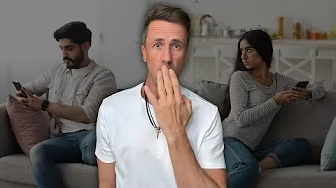
The Forgiven Spouse Manifesto: Part 3
This final part of the Forgiven Spouse Manifesto is about moving through conflict without losing each other in the process.
And I want to start with something I know will be controversial:
If you find yourself losing respect or admiration for your spouse mid-conflict,
Or if you find yourself not really liking your partner as a person anymore,
That’s more of a red flag about you than it is about them.
Allow me to elaborate.
When I hear that someone no longer respects, admires, or even likes their spouse, it tells me something:
You may have developed a pain-saturated view of your relationship.
You’re no longer just seeing what your spouse did.
You’re seeing them through what they did.
And those are two very different things.
One of the most important things we can learn in marriage is how to separate what someone has done from who they are.
That gets infinitely harder when we lose our likability for them.
Which is why, when a relationship becomes overwhelmed by pain, one of the first places I want to go is back to likability.
Back to being able to say, even mid-fight:
“I really don’t like what you did to me right now. But I still like you.”
Or even:
“I don’t like what you did. But I still choose to like you.”
Pain is inevitable in marriage. But marriage requires us to learn how to move through it.
I want you to imagine yourself as a rock in a river. The water hits you…
But instead of violently splashing off you, you allow it to flow around you.
Too many of us do the opposite in marriage.
We experience every disappointment, insensitive comment, or forgotten promise like it’s soaking us from head to toe.
Until eventually we become so full of pain that there’s nothing about us that pain doesn’t touch.
I want to help you stay dry. I want you to learn to recruit your spouse into a get-rid-of-pain campaign.
That starts with telling them:
“I’m upset.”
“I’m unhappy with what happened.”
“I’m hurting.”
But instead of immediately making them the target of your pain, ask them to help you eliminate it.
Let them help you to not get soaking wet with it.
A marriage can be good and still have problems
Everything I’m saying assumes something important.
There are certain covenants that have to exist inside a marriage:
Loyalty. Honesty. Fidelity. Transparency. Commitment.
When those things are actively being violated, or when there is ongoing deception, infidelity, or dishonesty, we have something different to repair.
But I meet so many couples who tell me:
“Our marriage is terrible.”
And then I look closer and discover….
Nobody is lying or cheating. They’re loyal and committed. They’re transparent and have built a life together.
They just fight.
And when I discover they don’t like each other very much right now, or intimacy has disappeared, I find myself wanting to say:
“Zoom out.”
You may not have a bad marriage. You actually have a beautiful marriage… just with problems.
There’s a difference.
The pain-saturated couple sees the problems and concludes the marriage is bad.
The joy-saturated couple can see the problems and everything else that’s beautiful.
Every marriage has its soft spot.
The question is whether we allow that vulnerability to exist without protecting it.
Let me ask you:
When did we give up the job of protecting each other?
When did the person who was supposed to defend us become the threat inside our home?
The faster we can cultivate joy, admiration, respect, and likability again, the easier it becomes to let pain move through us rather than accumulate inside us.
Betrayal creates two journeys
When there has been a gross breach of the covenant of marriage, something unexpected happens.
Both spouses are suddenly thrust onto a journey.
But they’re not on the same one.
The person who broke the trust has to go on a journey of maturity. They have to wake up to the reality:
“I hurt someone I love through my actions.”
And then they have to decide what kind of person they’re going to become.
It’s not enough to say:
“I won’t do it again.”
You have to go deeper:
“I don’t want to be someone who hurts my spouse like this anymore.”
I absolutely believe people can change.
I believe someone can lose their moral compass, do something devastating, wake up to what they’ve done, mature, and spend the rest of their life being loyal and devoted to the person they once hurt.
But the betrayed spouse wakes up on a different journey. And they didn’t choose it.
Last night, they went to bed thinking they knew their spouse, and their marriage.
Today they discovered their spouse betrayed them.
Now they’re on a journey of forgiveness.
And in many ways, I think that’s the harder journey. One person chose the actions that put them there. The other person had the journey thrust upon them.
But both journeys require maturity. And the thread that connects those journeys is forgiveness.
I don’t believe you can have a truly Chosen & Cherished marriage while permanently withholding forgiveness from your spouse.
Relationships thrive on oxygen and forgiveness is what delivers it.
Stop turning behavior into identity
This matters even in ordinary conflict.
When people swear, call names, or say deliberately hurtful things during fights, they’re often trying to soothe pain with more pain.
They’re looking for what might feel good for five seconds.
But now there’s another wound… and another.
Maybe you have two wonderful weeks and then one terrible fight. You can tell yourself:
“We’re a couple that has terrible fights every two weeks.”
Or:
“We’re a couple that has amazing weeks that occasionally get interrupted by a fight.”
Those aren’t the same identity. And I think identity matters.
I struggle with anger, so I can acknowledge:
“I struggle to keep my anger from hurting my wife when we’re fighting. That’s my cross to bear.”
Because I bring that struggle into the light, now I can work on it.
Anger doesn’t have to own me. Indeed, I can struggle with something without turning it into who I am.
We need to extend that same grace to our spouse.
Because one of the most important things you can do during conflict is keep the conflict about behavior instead of identity.
“I’m angry about what you said.”
“I’m hurt by what you did.”
“I’m disappointed by what happened.”
“I’m not going to turn those things into who I think you are.”
Name-calling does the opposite. It attacks identity.
So try this instead:
“When I saw you do that…”
“When you said that…”
“This is how that landed for me…”
Talk about how you experienced their behavior without turning their behavior into their identity.
Most of the everyday hurts we inflict on each other can probably be boiled down to three things:
We were thoughtless.
We were lazy.
Or we were insensitive.
“If I’d thought better, maybe I wouldn’t have done it.”
“If I’d put in more effort, maybe I would have done it.”
“If I’d been more sensitive, maybe I would have recognized how much I hurt you.”
To never be thoughtless, lazy, or insensitive would require something none of us can offer:
Perfection.
Your spouse is going to fail you. And you’re going to fail them. The question is what happens next.
Get out of the courtroom
When pain overwhelms likability, couples enter what I call courtroom culture.
Suddenly, we’re no longer two people trying to repair something. We become litigators. I have my evidence. You have yours.
I defend my truth and you defend yours. And both of us fight tooth and nail to win our case:
Who was right?
Who was wrong?
Who hurt whom more?
Who owes whom what?
But here’s the problem: there’s no restitution that can perfectly match emotional pain.
How exactly do you repay someone for saying something that broke their heart?
How do you compensate them for days, weeks, or months of feeling unwanted?
How do you make the scales balance?
You can’t.
Which is why I believe the off-ramp from courtroom culture is forgiveness. Without forgiveness, we keep seeking a favorable verdict that remains elusive.
And eventually we turtle. We go into our shells.
Turtling looks like a husband who emotionally shuts down. It looks like a wife who gives the silent treatment for three days.
But the deeper turtling is the kind when we start hiding our heart.
We allow scar tissue to build. And while that scar tissue is accumulates, something else slowly drains away:
Our likability for our spouse.
Repair cleanly
Which brings us to repair.
When something hurts in your marriage, don’t spend three hours arguing about who’s at fault.
Ask:
“How do we fix this together?”
“What can we do differently next time?”
“What can we learn from this?”
“How can I make it up to you?”
Those questions matter because they’re rooted in curiosity. And curiosity tells your spouse: your perspective matters to me.
If forgiveness were abundant in our marriage, how much would we actually need to dissect the pain?
If we’re determined to make our spouse understand exactly how badly we’re hurting, then we grab the only person who isn’t drowning and pull them underwater with us.
But that’s the opposite of what we need.
If you’re drowning, you don’t need your spouse to drown too.
You need them to help you back onto shore.
Reconnect before you repair
When you’re in the middle of a fight, stop. Catch your breath. Let your body come down. And then come back to each other.
We need to reconnect before we repair.
Because repair is possible when two people genuinely don’t feel safe with each other.
Sometimes reconnecting is as simple as relaxing your shoulders. Or sitting beside each other instead of across from each other.
Take their hand. Touch their elbow.
And say:
“We’re going to fix this. But can we hug first?”
Your goal is to communicate:
“You’re safe.”
“I’m not going to attack you.”
“I’m ready to repair.”
Then move toward curiosity:
“How can we fix this?”
“What could I do differently?”
“What could I say differently?”
“How can I make it up to you?”
The moment you become genuinely curious, you’ve stopped trying to win.
And that’s the point.
They need to know that even while you’re hurt, angry, disappointed, or confused, you’re still trying to find your way back to them.
Pain doesn’t have to disappear for you to choose each other. Conflict doesn’t even have to disappear.
If we can stop turning pain into identity, and dragging each other into the courtroom, we can stop trying to win.
And we can focus on repair.
Which brings me to the one sentence that matters more than anything you can ever say to your spouse:
“I’m sorry for how I hurt you—intentionally or unintentionally.”
That sentence makes room for forgiveness.
That sentence protects your spouse.
And that message communicates…
That after everything we’ve been through…
I still choose you.
In solutions and strength,

P.S. If this manifesto helped you see conflict and repair differently, my new book, Choosing Us, will take you even deeper.
It’s available for preorder now ahead of its November 3 release.
Preorder your copy and claim your FREE spot in my six-week Chosen & Cherished Marriage Intensive (a $1,500 value) and start building a marriage where both of you feel chosen and cherished again.
Preorder Choosing Us and claim your bonuses here.