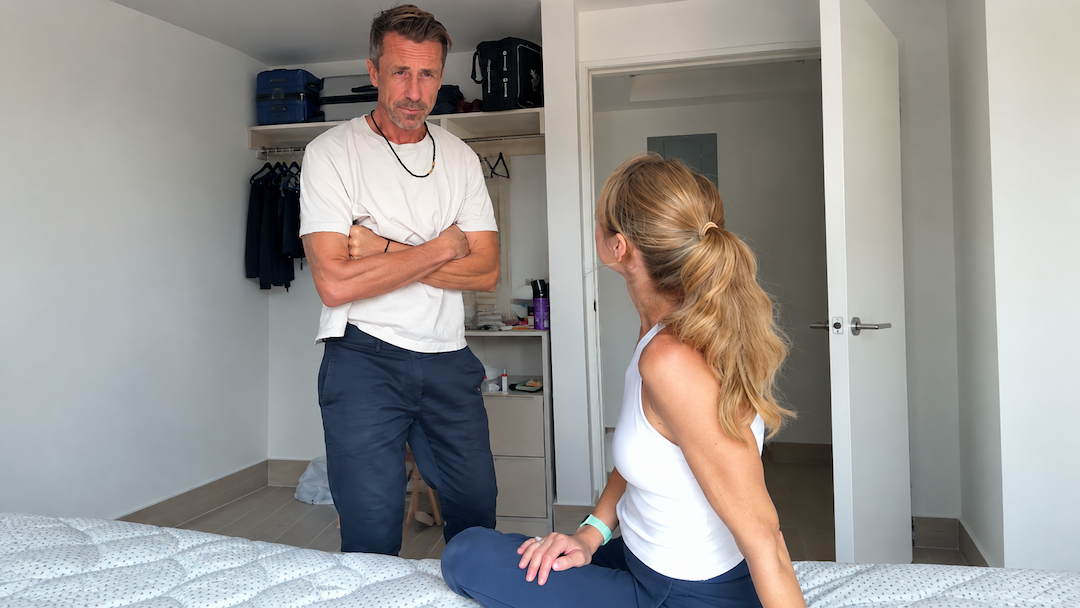
Are you and your spouse in the same marriage?

Happy Monday, everyone.

I want you to answer a question:

If I asked you and your spouse today to privately score your marriage on a scale from 1–10, how confident are you that you’d write down the same number?

Don’t answer that too quickly.

I’ve worked with enough couples to know one thing to be true:

Two people can choose to wake up every day in the same bed, be committed to one another, and still be living in two different marriages.

I’m sure you can imagine the scenario…

One spouse thinks:

“Things are fine. We’re fine.”

While the other is quietly thinking:

“I don’t know how much longer I can do this.”

Then you’ve got the broken connection hypothesis: One thinks the problem is the intimate connection and the other the emotional.

And that’s what makes communication so hard to fix. It becomes infinitely harder to repair something when the two of you can’t agree on what’s broken.

And yet, most couples come into my office claiming that if communication was better, their marriage would be better.

But that doesn’t work because they want the medicine, but haven’t agreed on what they’re treating.

So here’s something I want you to do tonight with your spouse.

Ask each other:

“On a scale of 1–10, how chosen do you feel in this marriage right now?”

Then, write your number down, but don’t say it out loud until both of you have a number.

Then show each other.

Whatever number you guys write down, you first need to know that no number is a bad number.

It’s just like taking your pulse. It can – and will – fluctuate.

So resist the urge to feel hurt.

Don’t attack your spouse because you don’t agree with their number.

You want to get curious first. Which leads me to the next question you guys are going to ask:

“What’s a small thing we could do that would move our numbers up? Even if that’s just from a 4 to a 5, or 6 to a 7?”

I’m not asking you to start fixing everything this instant.

What I want you to do is understand: what are the small moments that make your spouse feel chosen and cherished?

And more importantly: what are the things that make them feel happy to be married to you?

When couples start being able to have these conversations, they open up the possibility for movement and repair – or at least clarity around what’s next. And that’s why I created my Marital Inventory.

Before I can help a couple figure out where they’re going, I have to understand where they’re at – and what moves the needle in the right direction.

The Inventory walks you through the different areas of your marriage so you can see what’s working, what’s not, and most importantly, how your marriage feels different to both of you.

Again, the biggest problem in a marriage isn’t the score…

It’s the distance between your scores.

Right now, the Marital Inventory course (normally $250) is included as part of the Choosing Us Pre-Order Experience.

But, on September 1st, the Marital Inventory disappears from the Pre-Order Experience.

After that, anyone preordering the book won’t get access to it.

Meredith and I created the Pre-Order Experience this way intentionally.

We don’t want you to order the book today and have to wait until November 3rd to start working on your marriage.

In my experience, couples in pain want change now – and that’s what I want to help them do.

So if you enjoy my work, and are looking for the best way to support me, nothing would mean more to me than seeing your preorder of Choosing Us come in.

But if you’re going to preorder, do it before September 1st.

Because I want you to have immediate access to the Marital Inventory so the two of you can figure out where your marriage actually stands, where it’s going… And how to get there.

Use this link to preorder your copy of Choosing Us.

In solutions and strength,
Image item
aka “Mr. Chosen & Cherished”

P.S. I’ve also started something new, and fun: a Substack. 

My publisher asked me why I hadn’t started earlier. And truthfully, I’d never even heard of Substack.

But I have to say, since creating Inside My Therapy Room on Substack, I’m having a lot of fun sharing longer essays, personal stories, and ideas I can’t fit into an Instagram caption.

If this Chosen & Cherished Letter is your thing, I think you’ll love my content over there.

Here’s the link to find me.

The Forgiven Spouse Manifesto – Part 1

Before you read any further, you have to promise me to do one thing first: you’ll open your mind.

That’s job number one.

I’ve got two more parts of this manifesto and what’s more important than anything I’ve written is the action you’re going to take between reading each part.

But you won’t take action if your mind isn’t open.

Back in January, I attended a challenge to grow my Instagram. I loved it because it got me to take action for five days. But the minute the challenge was over, I stopped taking action.

Now, that’s the kind of risk any challenge or manifesto comes with.

You release little bursts of energy to make your relationship successful.

And then you stall.

That’s not what we do here.

We’re not looking to complete the next quarter mile.

We want to go the distance. We want to run the full marathon.

Hopefully, what you’re about to read will convince you enough that when you take the kind of action I’m asking you to take, you’ll start to build a marriage that makes you feel chosen and cherished.

Now, let’s dive in.


A follower left me a comment:

“Jonathan, you put yourself out there as if your marriage is perfect. Don’t you ever feel anger or sadness inside your marriage?”

That comment prompted me to write this manifesto…

Because it reveals a really big problem couples face today:

The language you use inside your relationship informs how you view your relationship. And how you view your relationship informs how well your relationship works.

That revelation is really my entire life’s work.

So when I replied to that person and said, “I don’t have anger or sadness toward my wife inside our relationship,” I wasn’t speaking a word of a lie.

Can I feel frustrated with Meredith? Absolutely.

Can I be irritated? Of course.

Two minutes before I started writing this manifesto, Meredith was trying to explain to me how to fix something in Canva, and I felt like she was only confusing me more.

But irritation and frustration are not the same as carrying anger or sadness toward my wife.

Meredith and I regularly experience moments of irritation.

Let me fill you in on a little context to explain what I mean…

Right now, we’re visiting family in Canada, after 5 long years.

Needless to say, our family system is a little disrupted right now.

There are lots of emotions and expectations hanging in the air, and consequently, our interactions are filled with a little more friction.

But do Meredith and I allow that friction to become anger and sadness towards one another?

We don’t.

Because we don’t use those words in reference to our relationship or each other.

We’ve made a conscious decision to separate the negative emotions we feel from the person we’re married to.

This is one of the most important distinctions I’m going to make in this manifesto:

You do not need to use anger or sadness in reference to your spouse, as in,

“They’re selfish.”

“They’re a disappointment.”

“They’re impossible to trust.”

This manifesto — and all of my work — is built around sending your spouse the opposite message – and one that’s positive:

“They’re chooseable.”

“They’re cherishable.”

Those are the only two identity-level messages worth sending.

And coincidentally the messages we all crave to hear most from the person we love.


So what happens when we don’t hear that we’re chosen and cherished?

Well, we have to fill that silence with something… and in my experience, people fill it with pain, sadness, and resentment.

But there’s an antidote to that emotional decay…

And that antidote is consciously cultivating positive emotions towards your spouse.

You see, you get to decide which emotions you attach to your spouse’s identity.

Be that the positive ones, or the negative ones.

Meredith and I have long decided that anger and sadness are not emotions we will hold toward each other as people.

And it’s been that decision to which I credit our strong connection.

Interestingly, if you’re a parent, you already understand this distinction.

When your child behaves poorly, you’re careful not to tell them they are bad.

You do whatever it takes to separate who they are from what they did.

But when our spouse hurts us, we often lose that same vigilance.

Over time, we start to let their behavior become their identity — and eventually, it becomes the only thing we can see.

That’s where I want to take you in this manifesto.

I want you to show up in your relationship with grace – in the same way you do for your children.

Of course, I can help you begin to see your spouse differently. I can help you create the conditions in which love, desire, affection, and trust can grow again.

But I need to convince you of something first.


Most of us already know how to lose weight and get in better shape. It’s not that we don’t know how to improve our health. The problem is that we often lack the desire to do it.

And that’s the one thing I cannot give you.

I can show you how to eliminate the anger and sadness you hold toward your spouse.

But I can’t make you want to.

Which brings me to the first challenge I have for you:

Can you decide, right here and now, that you’re both capable and deserving of a better marriage?

Are you willing to say, “I want a chosen and cherished marriage, and I’m willing to do whatever it takes to have it.”

If you hesitate to make that statement for yourself, then I know why.

It’s because something is getting in the way. And that something is pain.

Pain caused by all the hurts, unmet expectations, and missed opportunities to remind each other that you choose them.

And that makes sense.

Most couples become so consumed with what went wrong that they stop asking what they want to go right.

After 10,000 hours of working with couples, one thing has become clear:

Forgiveness will feel unattainable if your relationship keeps revolving around the hurt.

At some point, you have to decide that a better future is worth the effort to create it.

Now I know, this becomes infinitely harder when your spouse has betrayed you.

Whether physically, emotionally, or financially.

So how do you separate who someone is from what they did when what they did radically changed how you see them?

How do you forgive someone without excusing their behavior?

And how do they earn redemption without expecting you to stop hurting?

Those are some of the biggest questions I answer in my upcoming book, Choosing Us. And I’m not going to give all the answers away here.

But I will tell you this:

Forgiveness does not begin by pretending the betrayal didn’t happen.

It begins by deciding that your spouse is still more than the painful things they’ve done.

Whether that decision ultimately saves the marriage is another question entirely…


One thing is true:

The more you pour into someone — the more you love, respect, and admire them — the more you earn the right to call them to a higher standard.

I like that thought because it reminds me that when you treat your spouse with kindness and grace, you can call them to treat you better.

For me, the key that opens the lock is sending your spouse one beautiful, identity-level message:

“There are still parts of you I like, even though I deeply dislike what you’ve done.”

What you’re saying is that what they did changed how you see them, but it doesn’t have to become the only thing you see.

That simple phrase gives us a new starting point from which we can begin painting a different picture of your marriage — one in which both of you can feel chosen and cherished again.

We need to change how we understand forgiveness because it’s extremely difficult to forgive someone while continuing to send them the message that they’re no longer worthy of being liked, valued, or respected.

To understand the power of this work, you have to abandon some long-held beliefs for a second.

Let’s start with scorekeeping.

You can’t build enough connection to repair a marriage if forgiveness is reduced to an equal exchange of effort.

At some point, you have to move beyond what each person has done and begin asking whether emotional connection can exist despite the hurt that lives underneath each other’s behaviors.

In simpler terms, you have to start with my second challenge to you:

Ask yourself:

“Is there anything about my spouse that I still like?”

I’m asking you to answer that question because most relationship advice teaches couples to focus on the wrong things – the first being your differences.

The problem with focusing on our differences is that they become the root of our dislikes.

Forgiveness on the other hand requires us to recover a sense of what we still like about each other, what we have in common, and how we are the same.

Sure, our differences may explain parts of us.

But they rarely remind us that we belong together.

So, what does it mean to be in a relationship where you feel like you’re the same? Feel like you’re chosen and cherished?

For starters, it will feel like you and your spouse wake up every single day with a mission to send each other the message that you still choose them.

“But how does sending that message translate into forgiveness?” I can hear you asking.

Let me explain by asking you to complete my third challenge.


Ask yourself:

“What happens to resentment when you send your spouse the message that you see the good person you know they are?”

When they hear you asking yourself if there is still good in them, you create an opportunity for them to make a shift.

Instead of believing they will forever be defined by their worst behavior, they may begin working to become the person you still believe they can be.

In layman’s terms, you make it easier for them to begin sweeping their side of the street.

How’s that?

Because you are reminding them that they are more than their mistakes.

Sure, that doesn’t erase addictions, mental-health challenges, or harmful behavior.

Or sexual transgressions.

Or their lying, indifference, or lack of desire for affection and intimacy.

And you certainly won’t see a change in them overnight.

But asking if you can still see the good in them creates one very important condition necessary for repair: the belief that their redemption in your eyes is still possible.

I’ve said it before, and I’ll say it again: my approach to pain, forgiveness and repair is different from the mainstream.

Other therapists and ‘experts’ will want you to dissect the pain.

Relive the event.

And analyze the negative patterns of your relationship.

But that often doesn’t work at the pace we want it to.

That’s because no one moves when they feel bad about how they’re seen (and who they are) in the eyes of their spouse.


And now we come to the second-to-last challenge I have for you today.

I want you to ask yourself,

“Do I like my spouse as much today as I did when we first met?”

If you can’t answer yes to that question, it’s because pain, frustration and resentment have triggered a loss of likability.

And now, the hurt that comes with that loss obscures every good thing your spouse does, and every admirable quality they still possess.

I see this in couples who have been married for decades.

Their spouse has remained loyal, committed and present — yet those qualities disappear beneath a collection of hurts.

The thing is, likability doesn’t have to disappear.

Here’s a case in point.

Meredith leaves her breadboard and crumbs on the counter almost every morning.

I can choose to focus on the crumbs, or I can remember that this is a woman who has never lied to me, never cheated on me, and has stood beside me through thick and thin.

That’s a small annoyance – I get that.

But it’s poignant because it reminds me that forgiveness requires you to begin looking for the parts of your spouse you still genuinely like – and not just the small ways in which they annoy you.

I’m not telling you to ignore the hurts.

Or that they don’t matter.

But the hurts your partner causes you cannot remain the only thing you see about them.

If you let pain and resentment change how you see your spouse, it will change which parts of yourself that you give them access to.

You will guard yourself.

You’ll stop reaching for them.

And eventually, both of you will become more invested in self-protection than reconnection.

Thankfully, we have ways to fight that disconnection.


In Choosing Us, I share two vows that I ask couples to consider — one grounded in selflessness and the other in self-reflection.

Together, they change the question from “When will my spouse finally change?” to “How are we choosing to show up today?”

I’m going to resist unpacking those vows here because they deserve more than a short explanation.

Just remember that forgiveness doesn’t ask you to deny what happened.

And it definitely doesn’t require you to carry your marriage alone.

It asks whether you are willing to stop making your spouse’s worst behavior the final verdict on who they are as a person.

Whether your marriage survives or not, your freedom from pain may begin when you can see them as a human being who caused you pain — not as the embodiment of the pain itself.

My final challenge to you:

“Can you separate who your spouse is from what they’ve done?”

That is where forgiveness begins.


Before Part 2, I want you to write down your answers to all these challenge questions:

1. Are you willing to say, “I want a chosen and cherished marriage, and I’m willing to do whatever it takes to have it.”

2. “Is there anything about my spouse that I still like?”

3. “What happens to resentment when you send your spouse the message that you see the good person you know they are?”

4. “Do I like my spouse as much today as I did when we first met?”

5. “Can you separate who your spouse is from what they’ve done?”

Remember to focus on the qualities you still genuinely like about your spouse — most importantly, the parts of who they are you still like that their worst behavior hasn’t erased.

You don’t have to share it with them yet.

You just have to prove to yourself that the pain isn’t the only thing you can still see.

In solutions and strength,
Image item
aka “Mr. Chosen & Cherished”

P.S. As you dig into the coming parts of the Forgiven Spouse Manifesto, I want to invite you to join me inside the Choosing Us Pre-Order Experience.

When you preorder Choosing Us, you’ll get workshops, the Marital Inventory relationship assessment, and most importantly, a spot in our six-week Chosen & Cherished Marriage Intensive beginning in November.

That’s $2,250 in bonuses — absolutely FREE with your preorder.

If you haven’t ordered Choosing Us yet, preorder your copy and claim your bonuses today.

I Never Start A Sentence With “I Need”.

THE DESIRE MANIFESTO

The more you talk about your needs, the less your spouse wants to meet them.

How do I know that?

Because 10,000 hours of working with couples has made one thing crystal clear to me:

When you say ‘needs’ to your spouse, the hair on the back of their neck stands straight up.

You’ve probably heard the cliché advice that healthy communication means clearly expressing your needs.

But let me break something down for you:

Every time you say, “I need you to listen more,” “I need you to be more affectionate,” or “I need you to prioritize me,” they don’t hear what you’re longing for…

They hear pressure. Obligation. Another expectation.

And another way they’re failing you.

Eventually, the very person you’re trying to pull closer begins moving further away.

That’s why I want you to stop talking about your needs… and start revealing your desires.


I was working with a lot of couples this week, and the ‘needs’ theme came up way more than I like.

Now, I’m not saying we don’t all have relational needs.

Of course we do. We all want to know that we matter, and that our spouse cares enough about our connection to protect it.

What I am saying is that calling something a need does not make your spouse more willing to give it to you.

More often than not, they become defensive.

They shut down.

And leave you feeling so alone, you wonder if they even heard you.

Well, I heard you. And that’s why I’m writing you this manifesto.

To share with you a different perspective of how to get what you want from your spouse.

And I’m so confident that once you understand why the word ‘needs’ is damaging to your relationship …you’ll stop using it like Meredith and I have… and build a marriage that feels chosen and cherished.


People turn their wants into needs because they’re afraid.

They think that simply wanting something isn’t enough.

They think their desires won’t matter unless they can prove they’re hurting.

So “I want more affection” becomes “I need more affection.”

“I want to feel close to you” becomes “I need you to make me feel loved.”

Underneath all of it, you’re really asking:

“Will what I want matter to you?”

“Do I have to be falling apart before you’ll take me seriously?”

“Will you choose to care about me if I can’t force you to?”

What you don’t understand is that your spouse is human.

Sometimes they’re tired. 

Sometimes they’re thoughtless.

Sometimes they’re distracted, resentful, overwhelmed, or simply incapable of giving you what you want–in that moment.

If your ability to be okay depends entirely upon your spouse consistently meeting your needs, you are setting both of you up to fail.

Pretty soon, every misstep or missed moment becomes evidence that:

“I don’t matter.”

“I’m not important.”

“I’m not chosen.”

That is how one disappointment becomes an identity-level wound… and how a marriage slowly grows cold.


Most of us were never taught to live from desire.

We were taught to be realistic. To lower our expectations. To accept what we’ve been given and stop asking for more.

Eventually, we lose faith in two things:

That we are worthy of what we want.

And that we are capable of getting it.

So instead of building the marriage we desire, we keep presenting each other with an inventory of everything we still need.

“I have a need, and you need to meet it.”

“I have a need, and you have to fulfill it.”

When you live inside that scarcity mindset, you begin looking only for the moments when your partner doesn’t meet your needs.

That’s not how I do therapy. It’s not how I live my life. And it’s definitely not how Meredith or I approach our relationship.

We look for the things we want.

And we simply ask for them.

If couples became better at asking for what they wanted instead of repeatedly prosecuting one another for their unmet needs, I believe many of their hardest conversations would change almost overnight.

That’s not because every desire would suddenly be fulfilled.

It’s because desire is much more inviting than obligation.

Imagine you said:

“I want to feel your arms around me tonight.”

That isn’t an accusation.

It’s an invitation.

You haven’t told them how they’re failing.

You’ve shared with them how you want to be shown love.

Through my experience—having worked with well over a thousand couples and now being in my twelfth year doing couples therapy—I’ve watched this happen again and again.

The moment you make a conversation about unmet needs, it becomes acrimonious and resentful. 

One person feels deprived. The other feels inadequate. And both leave feeling more disconnected.

Now, I’m not a fool and am well aware that there are conditions a marriage requires to be healthy.

Loyalty. Honesty. Transparency. Fidelity. Commitment.

I’m not asking anyone to demote those into casual preferences.

I’m talking about the hundreds of ordinary moments in which we try to make our desires more important by presenting them as emergencies.

You shouldn’t have to manufacture an emergency for what you want to matter.

I want you to imagine two homes.

In the first home, everyone talks about what they need.

“I need you to help more.”

“I need you to listen.”

“I need more affection.”

“I need you to change.”

Everyone is keeping an inventory of what hasn’t been given. Everyone feels deprived. Everyone else feels inadequate.

Now imagine another home.

A home where everyone feels safe enough to reveal what they deeply want.

“I want to feel close to you.”

“I want more time together.”

“I want to know what’s happening inside you.”

“I want to feel your arms around me.”

In that home, nobody is guaranteed everything they ask for.

But nobody has to be ashamed of wanting it either. 

Or, more importantly, asking for it.

Nobody is so desperate that they have to convert a want into a need to get their desires to be taken seriously.

Which home would you rather live in?


I know what some of you are thinking:

“What if I tell my spouse what I want and they still don’t care?”

Then the problem is no longer your vocabulary.

Changing “I need” to “I want” will not cure indifference. It will not make an unwilling spouse suddenly become invested in your marriage.

But it will reveal something important.

There is a difference between a spouse who doesn’t understand what you want, a spouse who cannot give it right now, and a spouse who simply refuses to care.

You need to know which one you’re dealing with.

Desire does not guarantee that your spouse will move toward you.

But it gives them the clearest possible invitation to do so.


18 years deep, Meredith and I have never talked about our needs.

We simply tell one another what we want.

Not because we always get it. 

Because we’re not afraid of each other’s response when we hear it.

We don’t want to live in a home where it’s unsafe to say the thing under the thing.

Case in point:

My daughter came to me last year and said, “Dad, I want a horse.”

Should I have said ‘no’ and crushed a little girl’s spirit? Should I be the kind of father that ends a potential Olympic equestrian rider’s dream before it even started?

I wasn’t about to put a horse in our backyard the day after she asked.

But I’m not in the business of shaming my daughter for wanting a horse.

I’m in the business of being curious. 

Curious enough to ask, “Sweetheart, how can I help you get that horse?”

At 50, I want a PlayStation 5. Meredith doesn’t want me to have one (and honestly, she may be saving our family from losing me to Call of Duty).

The point is not that everyone gets everything they want.

The point is that a loving home makes room for people to express what they do want.

Sometimes–very often actually–we say no to each other. 

But not before we explore the request. Negotiate it. Postpone it. Or find another version of it. 

And we definitely don’t make one another feel foolish for wanting it.

I want you to get in touch with your desires. And then practice saying the two simplest words in your marriage:

“I want…”

As in, 

“I want intimacy.”

“I want a hug.”

“I want you to sit beside me.”

“I want a message from you when we’re apart.”

“I want to feel important to you.”

“I want to understand you.”

“I want to feel chosen by you.”

You don’t have to turn your desire into a need to make it legitimate.

You don’t have to collapse because it feels like you’re not allowed to ask.

You don’t have to prove that you cannot survive without it.

You are simply allowed to want something because it would make your life—and your marriage—more beautiful.


So I’m going to challenge you to talk to your partner tonight about what you truly want for your relationship.

Ask your spouse:

“What do you want for us?”

Not, “What do you need me to fix?”

Not, “What have we failed to give each other?”

Once again, ask each other, “What do you want?”

Then listen. Listen without defending yourself.

And be curious about why they want it.

Remember, your spouse doesn’t expect you to fulfill all of their desires.

They simply want to know that you care about what matters to them.

In solutions and strength,

Jonathan


P.S. If you want to go deeper into everything I talked about today and build a marriage that doesn’t feel disappointing, I wrote a book for you.

Choosing Us is available for preorder now through Amazon, Barnes & Noble, Walmart, and wherever books are sold.

Just do me one favor: when you preorder your copy, send me a DM or reply to this email and let me know.

Because this November, when the book launches, I’m personally leading a 6-week Chosen & Cherished Marriage Intensive, and everyone who preorders the book gets a spot completely FREE.

You’ll also receive all of the preorder bonuses (valued at $2,250) I’ve put together to help you start strengthening your marriage long before the book arrives.

I can’t wait to share my book with you.

Don’t End Your Marriage Just to End the Pain

My “Keep” Manifesto

Alright everyone, let’s get real.

If you’re here, it’s because you’re feeling the weight of a partner leaning out of your relationship. 

If that’s happening, and you’re not ready to give up…

This is going to be worth the 5 minutes it’s going to take you to read.


I was watching HopeScope the other day with my two daughters. (She’s a funny YouTuber who buys mystery boxes from TikTok and films her reactions as she opens them.)

My favorite part is that she has no idea what’s inside until she opens the box.

It got me thinking that the future of your marriage is exactly the same.

And that’s especially true for couples in a really rough place…

… where one partner is leaning into their marriage and the other is leaning out.

The biggest mistake anyone can make is deciding their marriage is over before they’ve actually explored every possibility for it.

I’d argue that if they’re willing to open their mind, then this may just help you pull them back into your relationship.


When someone is leaning out, they’re struggling with commitment ambivalence. 

And if that’s the case, you (as the leaning-in spouse) need the kind of language that’ll help you really understand what’s going on, and more importantly, how to approach them as the leaning-out spouse.

So let’s get into it.

The first thing you need to do when you see the train leaving the station is slow it down.

You do that with language.

I obviously don’t know your situation. And every marriage is different. 

But I do know this: the biggest decisions of your life shouldn’t be made from the narrowest emotional perspective.

And that’s why the first question isn’t “Why are they leaving?”

The first question is, “What problem are they trying to solve?”

The language you use at this moment matters more than you probably realize.


If you engage with them by attempting to process emotions or understanding why your connection has decayed, you run two risks:

  1. You’ll connect your spouse to the thing they don’t want: the pain of why you’re not connected
  2. You’ll stay stuck talking about that pain for 52 weeks without circling back to what’s going to move the needle and repair what’s broken.

Neither of those stop the runaway train.

And that’s not what I teach.

You need language that slows the train down.

You have to understand—and this is especially true for those of you wanting a new language to communicate with your spouse—that when someone is truly contemplating leaving a relationship, the very first thing they’re trying to do is end the pain.

When they express a desire to leave, here’s what they’re thinking:

Leaving the relationship is the only solution worth attempting.

Why?

Because your spouse isn’t trying to leave you.

They’re trying to leave the pain.

And if you’ve been carrying the weight of trying to save your marriage alone, I know how lonely that feels.


In therapy, we talk about attempted solutions.

Why do people do the things they do in life? 

Because those are attempted solutions that will let them escape the pain they’re in.

Everything we do is an attempted solution to solve some problem we’re experiencing.

Let’s say I need to fix my car. 

One attempted solution is, “I don’t want to fix it. I’m going to sell it, take the money, and buy a new car.”

That’s an attempted solution. But it’s not always the best solution.

And if you’re the one who’s pulling away from your marriage, it’s really important to understand this because you don’t want to be making a life-changing decision without seeing it for what it is.

Let’s say you throw in the towel on your relationship.

I’ve seen this.

I worked with a client—someone very successful in his career—and his wife threw in the towel. She didn’t want to rekindle the relationship.

He wanted to try.

She didn’t.

Today, he’s remarried.

She’s still alone.

I often wonder if she would’ve made the same decision had she believed there were other solutions worth trying.

If you’re the one leaning out and one reading this, you’ve got to understand that your decision to lean out—or even end the relationship—is simply an attempted solution.

It’s in your best interest to ask,

“Would I be open to talking about my decision, if there were other solutions we could attempt?”

If you’re the one leaning in and reading this, understand that they’ll only answer ‘yes’ to that question if they believe that exploring other solutions could be the best thing for themselves.

Most leaning-out spouses think, “I want the pain to stop because my relationship is all bad.”

The thing is, no relationship is all bad. 

But since they’re feeling that way, they don’t see that. 

They only think, “I’m in pain and the only way to end that pain is to end the relationship.”

What they don’t understand is that there are multiple steps before you actually throw in the towel.


So, just because they’re feeling pain, what other solutions could we attempt?

How could we stem the bleeding?

How could we stop the pain long enough for them to discover whether there’s still a little bit of gas left in the tank to repair the relationship?

I want you to remind them—using these exact words—that if they throw in the towel today, they may eventually regret that decision.

Tell them, “I don’t want us to live with regrets.”

“So what do you propose instead?” they may ask.

That’s when you pitch them the idea of zooming out and taking a 30,000-foot view of your relationship.

Simply ask them, “Wouldn’t it be in both of our best interests if we could get an unemotional, unbiased view of our relationship?”

This is the whole goal of the conversation you’re going to have with them at this point: 

Take an inventory of what is good, not just what’s painful.

Because no relationship is 100% painful all the time. Even those that hurt still contain moments worth protecting.


At this point, I want you to use this analogy with them:

Imagine that our relationship is a train.

The conductor has fallen asleep.

His foot is pressing harder and harder on the accelerator.

The train is speeding up, racing toward the edge of a cliff…

“Wouldn’t it be in both of our best interests if we got an unbiased look at our marriage?” 

Then pause a moment before continuing.

“Can I ask you something? If leaving is one solution… would you be willing to spend one hour making sure it isn’t the only one?”

Your only goal is to get them to pause on making a decision about the relationship–be that to leave, to separate, or ask for space.


Your main focus when your partner first brings up the idea of separation is to stop them from acting on their attempted solution.

How?

Let me give you more language to use with them…

Would you ever take your car to a mechanic and say, “Just start pulling parts out and replacing them?”

Of course not.

No mechanic starts replacing parts before running diagnostics.

The same thing is true of your relationship.

There are going to be painful parts. But there’s also going to be a lot of good.

If the two of you don’t take that 30,000-foot view—especially if one of you is leaning out hard—you run the risk of making an attempted solution based purely on emotion.

Usually, overly negative emotion.

No one should want to make major life decisions from an overly negative OR positive emotional state.

When you’re making an attempted solution, you want to confidence.

You want a clear, level head so you can decide what your relationship actually needs.

Every relationship knows hurt–mine included

But every marriage still has some good in it.

And it’s worth pointing that out.

Why?

Because, at the very least, it may have them thinking twice and hitting pause before making a life-changing decision.

And remember HopeScope?

She has no idea what’s in those boxes until she opens them.

The future of your marriage works exactly the same way.

Don’t decide what’s inside before you’ve opened it.

Your spouse may still leave.

Or they may not.

But before either of you makes the biggest decision of your life…

Make sure you’re ending the marriage because it’s truly over.

Not because you’re desperate for the pain to stop.

In solutions and strength,
Jonathan

P.S. If this resonated with you, I’d love to give you the exact Marital Inventory I use to help couples see more than just the pain in their marriage. I created it to help you step back, take an honest look at what’s working, what’s hurting, and what still might be worth fighting for.

Normally it’s a $250 program.

Right now, I want to give it to you absolutely free.

My upcoming book Choosing Us is coming out November 3rd. When you preorder it, you’ll get The Marital Inventory today along with $2,250 of other bonuses. These aren’t going to last forever. So if you want them, use this link and preorder Choosing Us today.

Don’t beg them to stay… Give them a reason to wait instead.

Happy Monday, everyone!
One of the hardest emails I ever get goes something like this:
“My wife says she’s done. She’s talking separation. What do I do?”
If that’s your situation, how you respond matters more than you realize.
If your spouse says they want out, then yes, your job is ten times harder than if they came to you months ago and said where their head was at.
Maybe they did. Maybe they didn’t.
None of that is important now because you have to focus on what you can do today.
What you have on your side is the fact that, in reality, very few people actually want to be single.
But many will trade the safety of a relationship for the freedom of getting away from pain.
Especially when they’ve reached the point of emotional exhaustion.
That’s the first hurdle you have to understand.
Their nervous system is fried.
Maybe it’s been your anger. Your defensiveness. Or your passivity… it doesn’t matter now what the source of their pain is.
Addressing that comes later.
The second hurdle you’re facing is just as important.
When someone has lived in pain long enough, they lose the ability to see the good that’s still there.
They can’t see that the person that they married still exists.
In fact, their pain makes it such that they don’t even want to look for that person.
That’s okay. It’s not their job to look for that right now.
It’s yours.
So what do you do?
You stop trying to convince them to stay.
Instead, your only goal is to make them feel safe enough to wait.
You might say something like:
“Sweetheart, I know I’ve hurt you. I’m not asking you to trust me today. I’m asking if you’d give me 24 hours at a time to show you I don’t have to keep being a source of your pain.”
Notice what you’re doing.
You’re not promising perfection.
You’re not asking for forever.
You’re simply asking for enough time to show them that you can be the person they needed all along.
If they agree to hit pause long enough to think, then you can ask a question that invites hope back into the room:
“If there was one thing I could do that would help you believe this marriage still has a chance… what would it be?”
(Side note: That question, I’d like to point out, isn’t something only people facing a crisis in their marriage need to ask. We can all rephrase it like this:“If there was one thing I could do that would make our marriage better… what would it be?”)
In closing, if your spouse can’t imagine a better future with you, there won’t be much to save.
But if you can help them imagine, even just a little, what different could look like, you may have something to build on.
Your goal right now isn’t to fix the marriage.
It’s to pause the pain long enough to give hope another chance.
In solutions and strength,
Image item
aka “Mr. Chosen & Cherished
P.S. If your marriage feels like it’s hanging by a thread, don’t wait until someone packs a suitcase. The earlier couples learn these skills, the easier they are to apply. If you’d like help, you can learn more about working with me by booking a call here.

What Happens When Couples Stop Liking Each Other

Dear Friend,

This is one of the most important things I’ve ever written.

It’s the foundation of the Chosen & Cherished Method I’ve taught to thousands of couples, the same framework Meredith and I used to rebuild our own marriage, and the heart of my upcoming book, Choosing Us, releasing November 3rd.

It’s a longer read, but if intimacy has become a struggle in your relationship, I think you’ll finish with far more answers than questions.

Let’s begin.

In solutions and strength,

Jonathan


Reading time: 15–18 minutes

THE INTIMACY MANIFESTO

When you wake up and realize that nothing you’ve been doing is bringing intimacy back into your marriage…

It’s discouraging.

You ask. You try. You have the conversation.

Maybe your partner promises to work on it, and things get better for a week or two…

Then you’re right back where you started.

Or maybe you’ve stopped asking altogether. The frustration got so heavy that you quietly gave up.

If that’s where you are, I want to challenge the way you’re thinking about intimacy.

Because I don’t think intimacy is the problem. I think intimacy is the symptom.

And if you spend all your time trying to fix the symptom…

You’ll miss what’s actually keeping the two of you apart.

So let me ask you the most important question I can ask a couple who’s struggling with intimacy:

How much do you actually like each other?


Why Liking Matters More Than Loving

I was inspired to write this by a man who had written me a DM the other day.

He asked, “How do we work through perimenopause? Or menopause? My wife doesn’t want to be intimate with me. What can I do about that?”

My reply to him was very simple.

“You’ve got to restore the likability inside your relationship.”

And I would say most trouble with intimacy, when it comes to couples, goes back to how much they like each other.

So, if you’re new to my work, let me take you to the idea that it’s not that we need to feel loved by our partner…

We need to feel liked by our partner.

And the reason for that is because men and women want two different things when it comes to their relationship.

If I were to ask one hundred women what they want from their relationship and from their spouse, they’re going to answer me that they want to feel like the most important woman in his mind, or their partner’s mind.

And men, you’ll often hear them say, “I want peace.”

For me, when a man says, “I want peace inside of my relationship. I want to feel like I can come home and it’s a peaceful home,” what he’s usually talking about is that he wants to feel respected.

Men often say they want peace.

I think what they’re really describing is respect.

Respect is simply what likability looks like in action.

When I know you like me, I experience that as respect.

Women, on the other hand, usually want to know they’re still the most important person in their partner’s mind.

Both of those point back to the same thing:

Liking each other.

So it’s not as important to love your spouse as it is to like your spouse.

Liking your spouse is vastly different from loving because loving just speaks to my feelings about you as my spouse.

It doesn’t speak to what I think of you.

Because we can all love people that don’t behave well, that treat us poorly.

Our neighbor.

Our mother.

Our uncle.

Our sister.

Our kids.

All of us know how to love someone that we don’t necessarily like, or like all parts of them.

But to truly like someone means that you look inside of them, you see who they are—their personhood—and you decide in your mind that they’re a likable individual.

So we’ve got this ledger of the people that we like and the people that we don’t like.

The challenge is that, for most people—and I hear this commonly, and I felt it with my own marriage with Meredith—I would often say to her, “Why do you treat everyone else with such love, kindness, grace, and patience, yet you treat me radically different?”

And vice versa, too.

I know a thing or two about putting my best foot forward.

I’ve had anger issues basically since I was sixteen.

And while I don’t have road rage, I get impatient when I’m waiting in line, and I don’t want to wait in line.

In spite of my anger issues, to random people I meet on the street, in the shops, in the supermarket, I can be very nice and kind.

But when it comes to my wife, I treat her in a way that is harsh.

Or I used to, anyway.

My anger was quick to trigger, and so she would say the same of me.

She would say, “Why don’t you treat me the way you treat everyone else?”

It was because there were parts of us, in that phase of our marriage, in that season of our marriage, that we didn’t like a lot about each other.

The reason for that is that when you ask couples, “How much do you like your husband?” or “Do you like your wife?” they’ll actually start naming off all the things that they don’t like about their partner.

If I were to ask you to describe your partner, if you were in a couples therapy session or a coaching session with me, I would direct you to write positive things.

But most people aren’t in the room with me when they ask themselves that question.

If they can’t describe their partner in a positive light, they’ll at least attempt to describe things that their partner is no longer doing as if that’s somehow a redeeming quality.

But the only redeeming quality—the only way that we should look at our partner—is we should first look at the things we like about them, the parts of them that we like, and turn the volume up on that, and turn the volume down on the parts of our partner that we don’t like.

In the same way that we do that with our kids.


The Two Ledgers Every Marriage Keeps

See, when our kids come home from school with their report cards and they show us a report card of four A’s and a C, we don’t immediately jump to, “Why did you get a C?”

Now, if you’re a Gen X like me and you grew up in that generation, your parents did start with the C.

But in this day and age, we know we want to treat kids… we want to lift them up. We want to encourage them to feel good about themselves, and we want to acknowledge their accomplishments.

So we would dive into the four A’s.

“Wow! I can’t believe you got those A’s. That’s so amazing. You’re so smart. You persevere. You’ve worked so hard.”

And we downplay that C that they got.

What we do with children, we don’t typically do with our own spouse.

So what happens, especially in relationships where there’s a lack of intimacy, is we will be downplaying the parts that we like about our spouse—downplaying them so much that we won’t even think of them, or talk about them, or name them.

And we’ll speak heavily about the things that we don’t like about them.

So when someone says to me that they find themselves in a sexless marriage, the question that goes through my mind is:

How much do you like your partner?

Because nobody wants to be intimate with someone they don’t enjoy being around.

This would be my challenge to you guys tonight.

Every marriage has two ledgers.

One lists everything that’s wrong with your spouse.

The other lists everything that’s right.

The marriage you experience depends on which ledger you keep reading.

Whatever you keep looking for… you’ll find more of.


Why Intimacy Is Really About Connection

Look at that part of yourself and ask:

“Am I noticing the things that I should be noticing about my partner? Or am I too stuck in a pain-saturated view of my relationship and my partner so that I can’t look past their mistakes? I can’t look past the parts of them that I don’t like, or the way that they show up, or their harsh tone sometimes, or their bad mood that they can be in?”

I’ve worked with couples where one partner stayed at home, the other worked. He provided really well. She took care of the home really well.

When I would ask them to describe each other, what they liked about each other, those things didn’t come up.

What came up was the pain that they felt inside of their relationship.

That’s common because I’m a therapist and a couples coach.

People come to me, and they’re not usually telling me about the things that they like about the relationship. They’re usually wanting me to help them fix the things they don’t like.

But I’m not in a session with you guys.

I’m just writing to you. 

But I want to challenge you the same way I would any other of my clients.

Challenge you to think about the things that you like about your partner.

People are going say, “Yeah, but Jonathan, that’s not fixing intimacy. It’s not gonna get us back into a physically intimate relationship.”

Well, I don’t want you to focus on that right now.

Because if you think about it, we can’t typically be physical with someone that we don’t feel emotionally connected to.


Stop Chasing Emotional Safety

Emotional Safety Is Too Binary

Now, I use connected as opposed to safe. The buzzword everyone wants to use these days is ‘emotionally safe.’

I use it in my content, and I write about this in my book that’s gonna be published in November, but let me tell you about why I actually don’t like the word safe.

It’s because it is too binary.

To me, connected is a better way to describe our goal with our partner.

Because if I were to talk about feeling safe with my partner, then the opposite, if I’m not feeling safe, must be that I feel unsafe with them.

Now, the challenge with using safe to describe your relationship is that it’ll launch into a conversation that focuses on the fact that you don’t feel safe.

So, until that moment that you feel safe with them again, you will feel unsafe.

It’s like a switch that gets flipped.

Then my question to you is:

“Well, what needs to happen to switch a marital relationship from unsafe to feeling safe?”

At that moment, what people will typically describe is all the things that they want to see and have to feel safe with their partner.

And that’s great. 

But what you’ll see in couples that are working on their relationship is they’ll make progress toward feeling safe again…

But then something will happen.

There’ll be a fight or some type of conflict, and they’ll backtrack.

They’ll take a step back.

Maybe we don’t go all the way back to square one.

Maybe we’re on third base, but we’ll go back to second.

Or maybe we’ll go back to first.

But we won’t stay at third anymore.

We’ll regress back to a further place of unsafety.

Now all we do is get stuck in this binary option of:

“My relationship is either safe, or it’s unsafe.”

Then we’ll get closer again to feeling safe.

Then something will happen again.

That pattern will rinse and repeat.

And this is the problem with making emotional safety the goal for your relationship.

I encourage you guys not to make emotional safety the goal for your relationship because it’s going to keep you stuck in the binary mindset of:

“As long as I’m not feeling safe, I must therefore be unsafe.”

Some massive amount of work is going to have to happen inside of your relationship to be able to flip that switch from unsafe to safe.

I prefer to use the phrase ‘emotionally connected’… because that can live on a spectrum.

Emotional Connection Lives on a Spectrum

Now, safety can live on a spectrum, but typically people don’t describe feeling safe as being on a spectrum.

It’s either:

“I’m unsafe.”

Or:

“I’m safe.”

Whereas if you talk about connection:

“I wanna feel connected to my partner.”

We open the door up to this spectrum of:

“We are somewhat connected.”

“We could be more connected.”

“We could be even more connected.”

Typically, when people talk about feeling connected, they don’t automatically jump to that binary:

“I’m either this or that.”

And I want you guys to key in on those words:

Either. Or.

Those two words are your enemy when it comes to a relationship.

Now, if people were good at describing emotional safety on a spectrum rather than that binary option, I would say, “Yeah. Then have at it. Make emotional safety your goal for your relationship.”

But again, odds are it’s either:

“I’m unsafe.”

Or:

“I’m safe.”

It’s usually not the gray area in between.

Whereas emotional connection can live more in a gray area because people don’t automatically jump there.

A Better Goal

So what you’re going to do for me is make a promise to your spouse, and a promise to yourself, that you guys want to make emotional connection the goal for your relationship.

Remove that word safety from your lexicon when you describe your relationship, and trade that for connection.

Then what you’re going to do is ask yourselves:

“On a scale of one to ten, where ten is deeply connected, and one is the complete other end of the spectrum, where do you guys find yourselves today?”

You’re going to get a number.

For some people it’s a five.

Others it’s a six.

Others it’s a two or a three.

Whatever number you’re at today, I want you to write that down.

Then you’re going to ask your partner to do the same.

You guys are going to define what your numbers are.

Whether that’s he’s a three, she’s a two.

You guys will split it in the middle and you’ll say, “We are currently a 2.5.”


The Three Questions That Change Everything

Then average those numbers out. Add them together and divide by two.

Then, you’re going to ask:

“If we’re currently a four today, what would a five look like?”

I want you guys to write that down.

“If we’re a four today, what would a five in emotional connection look like?”

Now, the reason why I’m asking you to do that in this way (and I’ve got two other questions you guys are gonna write down) is because, right now, I’m engaging your imagination.

Examine how these questions are phrased:

What would a five look like?

If we move from a four to a five, what would that look like?

What would we be doing at a five?

Those are questions meant to introduce the possibility of a better future because they lean on our imagination.

And with imagination comes positivity.

Remember, we’re not talking about emotional safety. 

We’re talking about emotional connection.

We’ve let go of those “either/or” statements:

“I’m either safe or I’m unsafe.”

“You’re safe or you’re unsafe.”

We’ve let those go because they’re negative.

And those words put us in a negative state.

1. Imagine the Future

Now you’re asking, “What would a 5 look like if we’re currently a 4? What would a 5 look like?”

Because I asked you in that way, you both are engaging your imagination.

See, imagination is positive.

Think about when we were kids. We all loved imagining what the first day of school was going to be like.

My daughter was imagining last month what her birthday party was gonna be like.

We all love to imagine things, right?

Imagining is positive.

That’s why, automatically, when we find ourselves making emotional connection the goal and we put it on a spectrum, it opens the door to us using our imagination.

2. Remember Your Best Moments

Now, the other thing that we’re gonna do is use a past-oriented question to arrive at that 5 again.

We can ask ourselves something like:

“When was the last time we were a 5?”

Or:

“What was an early moment in our relationship when we felt like we were a 5?”

Right there, when I put it in that past tense, I’ve engaged your memory.

Typically, I know a lot of us have traumatic childhoods and we have traumatic memories.

But memories can also be positive.

I know every single time I open up my iPhone, I actually almost cry because it always wants to do the carousel of your favorite photos over the years.

I’d see Aria, or I’d see Charlotte, and they’d be super young.

Like Aria when she was two.

Sometimes a video will pop up, and I can hear her voice.

I want to cry, but they’re tears of joy.

I want to cry because I’d give anything to go back to that day when she was that young.

Either way, memory is a beautiful thing because we can decide what we think about again, and we can decide what memories we want to recall.

So I’m asking you guys to recall the good memories inside of your relationship.

I’m doing that for a very specific reason.

I’m doing that because I know if I can get you thinking positively about your successful past as a couple, what’s that going to do?

It’s going to usher in hope.

People need hope in their lives.

They definitely need it in their relationships.

When you find more hope inside of your relationship by looking at your successful past, you’ll feel hopeful that you can recreate some of those successes in the future.

Now, because we’ve traded emotional safety for emotional connection, we have that continuum of the past, that continuum of the present, and the continuum of the future.

Because we’re on that continuum, we can look to our memory, and we can look to our imagination for the answers of how we can move from a 4 to a 5.

3. Create Today’s Next Step

Now I want to give you one present-tense way to ask that question.

“How can we go from a 4 to a 5?”

I want you to get together with your spouse and say:

“How could we move just one point up that scale, from that 4 to a 5?”

What I love about that question is now you and I can start brainstorming the little things that could happen today.

I’m not asking you to go from a 4 to an 8.

I’m asking you to go from a 4 to a 5.

Now, together, you can start brainstorming.

Assuming you couldn’t fail, how could you go from a 4 to a 5?

What is really nice about that question is now I’ve engaged your creativity.

And by asking you to think creatively, you’ll think positively.

So, in three questions, that past-oriented question, “When was the last time you felt like we were a 5?”; that present-oriented question, “What could we do to go from a 4 to a 5?”; and that future-oriented question, “What would a 5 feel like?”, I’ve engaged your memory, I’ve engaged your creativity, and I’ve engaged your imagination.


Curiosity Is the Opposite of Resentment

I want you guys to think about this.

This is all under the one very important umbrella called curiosity.

The opposite of resentment isn’t forgiveness.

It’s curiosity.

All three of those–the past, present, and future–were positive WH questions.

They weren’t the negative one.

I explain this in my book as well, so definitely go to Amazon, look it up. It’s called Choosing Us, and you can order it on Amazon. It’s gonna be out November 3rd.

In the book, I talk about the power of curiosity in a relationship.

All the questions I ask are meant to be the WH questions:

Who.

What.

When.

Where.

How.

But not the why.

Why don’t I want you guys asking the why question?

If I ask you guys, “Tell me, why aren’t you intimate today?”, that’s gonna connect you to all the reasons why your relationship doesn’t feel safe, or worse, why you don’t like your partner.

You’re going to start building a case in your mind.

And if you’ve already probably built the case in your mind, you’re going to want to articulate it to me.

So, at all costs, avoid the why question inside of your relationship.

Focus on the who, what, when, where, and how.


The Underlying Message of Curiosity

I arrived at a very powerful conclusion today with a couple that I was working with.

I asked them: 

What is the underlying message you send and receive when you show up with curiosity inside of your relationship?

What is the underlying message you receive when you ask each other using these five WH questions?

The underlying message is this:

“I’m deeply interested in what matters to you…

…so I can take aligned action to help you get what you want.”

That’s it.

That’s curiosity.


The Marriage Nobody Wants to Leave

I want you to remember this.

If two people wake up every morning asking,

“What matters to you?”

and then spend the rest of the day taking aligned action to help each other get it…

Neither one of them will ever want to leave.

That’s a Chosen & Cherished marriage.

To me, that is the warm blanket that keeps me sleeping soundly every single night.

It’s also the precursor to liking my wife, and vice versa.

Because how can we not like someone who is deeply interested in helping us get what matters to us?


But What If Nothing Changes?

Now, if you’ve done all of that and your spouse still doesn’t want to be intimate with you, then I think there are either two things going on.

Either you skipped too many of those steps and you moved too quickly through them, so you’ve gotta take it a little bit slower.

Or there’s what’s called a bad-faith actor present.

They’re not wanting to be in your marriage with good intentions, with good faith.

They don’t want to show up and make you feel chosen and cherished as much as they expect you to make them feel chosen and cherished.

Now, just because they don’t have good intent—good intentions—doesn’t mean you have to throw the baby out with the bathwater.

It could be that there’s pain there.

There could be hurt there.

There could be resentment there.

Well, to me the cure to all of those is curiosity, again.

Because you’re going back to that place where you’re asking them:

“What matters to you?”

And you follow up with: “I’m deeply interested so I can take aligned action and help you get what you want.”

That may take some time, which is why I tell you to go back and run through that whole exercise again, and again, and again.

With that aligned action, and that curiosity coupled with time, you will wear down that wall between you guys, and you will restore the emotional connection inside of your relationship.


Let Connection Grow

The nice thing is, because it’s not emotional safety, where it’s this binary switch from “I’m unsafe” versus “I’m safe,” we can see it on that spectrum of seeing our emotional connection grow.

The verb most often used when it comes to emotional connection is grow.

It’s not be.

It’s not:

“I am unsafe.”

It’s:

“Our connection can grow.”

Right?

That verb to be, leaves room for either, “I’m unsafe,” or, “I’m not unsafe.”

So we don’t use it. 

We ask:

“Can our connection grow?”

So put your relationship back on a spectrum.

Take it off that binary switch of, “I’m this,” or, “I’m that.”

Open yourselves up to use curiosity to bring it back inside your relationship, to heal those wounds, and restore that likability inside of your relationship.


The Final Thought

At the end of the day…

Nobody wants to leave a marriage where they feel deeply understood.

Nobody wants to leave a marriage where someone is genuinely curious about what matters to them.

And when two people wake up every morning asking,

“What matters to you?”

…they create the kind of marriage neither one of them ever wants to leave.

That’s a Chosen & Cherished marriage.


That’s all I have for you.

I know it was a lot. And I hope I didn’t move too quickly.

And if you want to go deeper into everything we talked about today, my Chosen & Cherished Method and how to build a marriage neither of you ever wants to leave, I wrote this book for you.

Choosing Us is available for preorder now through Amazon, Barnes & Noble, Walmart, and wherever books are sold.

When you preorder your copy, send me a DM or an email and let me know.

Because this November, when the book launches, I’m personally leading a six-week Chosen & Cherished Marriage Intensive, and everyone who preorders the book gets a spot completely free.

You’ll also receive all of the preorder bonuses we’ve put together to help you start strengthening your marriage long before the book arrives.

I’m incredibly excited to share this book with you.

You can pre-order your copy here.

Thank you for being here, for trusting me, and for allowing me to be part of your marriage journey.

Helping couples build marriages where they both feel chosen and cherished isn’t just my work… 

It’s my calling.

In solutions and strength,

Jonathan


The real reason they won’t go to therapy… It’s probably not what you think.

If my wife refused to go to therapy with me, here’s exactly what I’d do.
There’s something you need to understand about people who won’t go to therapy… or “work” on their relationship.
It’s usually not that they don’t want a better marriage.
Most do.
The cork in the bottle preventing them from doing any kind of couples work is often rooted in four emotions:
Fear.
Shame.
Guilt.
Or embarrassment.
But those aren’t really the problem.
The real cork is the belief that if they try, they’ll fail.
Think about it for a moment.
When was the last time you wanted to do something but didn’t because, deep down, you didn’t think you’d succeed?
The business you never started.
The workout plan that fizzled out.
The new hobby you gave up on.
People don’t like failing because failure forces them to look in the mirror and say, “I failed.”
So they avoid trying in the first place.
That’s why simply telling your spouse to “go to therapy” rarely works.
Before they’ll take a step toward your marriage, they need to believe they won’t fail.
And here’s the beautiful part.
You don’t have to convince them that therapy is the answer.
You simply have to remind them that the only true failure is refusing to take the first step.
I’m not asking you to give them hope.
I’m asking you to invite them into faith.
Faith that tomorrow can be better than today.
Faith that they can learn.
Faith that together, you can build something stronger than what you have right now.
It’s the same faith the two of you had when you stood in front of your friends and family and said, “I do.”
On your wedding day, you weren’t operating on hope.
You were operating on faith.
Faith that whatever came your way, you’d face it together.
That same faith can still exist today.
And if Meredith was reluctant to join me, this is where I’d start.
I’d look at her and say:
“Sweetheart, if we couldn’t fail…
If the only failure was not trying in the first place…
If we committed to learning more about each other, understanding each other better, and showing up better in our marriage…
Would you join me?
Would you believe that whatever we put our minds to, we could accomplish? That together, we could build a better marriage?”
Then I’d remind her that couples therapy isn’t the only path.
Reading a book together is a path.
Watching videos together is a path.
Taking a walk and having one honest conversation is a path.
Whatever path our marriage is meant to take, refusing to start down it is the only way we can guarantee failure.
But taking that first step — armed with the same faith we had when we said, “I do” — is a path I’m always willing to take.
In solutions and strength,
Image item
aka “Mr. Chosen & Cherished
P.S. We’ve been working behind the scenes on something really special for everyone who pre-orders Choosing Us. I can’t share the details just yet, but if you’ve been thinking about picking up a copy, keep an eye on your inbox on August 1. I think you’re going to be glad you did.

Why our arguments don’t scare us anymore… We still disagree – but we don’t let it own us.

Meredith and I know how to fight.
In fact, if fighting were an Olympic sport, the early years of our marriage would’ve gotten us on the podium.
Here’s what our fights used to look like:
One of us would get frustrated. The other would immediately sense it. Before long, we’d both be reacting instead of responding.
Sometimes I’d come in too hot.
Or she’d pull away emotionally.
Sometimes we’d switch roles just to keep things interesting.
The details would change. But the pattern didn’t.
That was 18 years ago.
Now, don’t get me wrong… we still disagree. In fact, we had one of those moments yesterday.
The difference is that our arguments don’t own us anymore.
They don’t spiral out of control and have us thinking about the exit like they used to.
That’s not by accident.
It’s because we’ve learned how to make each other feel safe while we’re in it.
When emotions start running hot, I remind Meredith that I’m not upset with her. I’m upset about something that happened.
And when she feels hurt by the way I’ve come across, we know how to slow things down, repair the moment, and find our way back to each other.
Eighteen years ago, we didn’t have those tools.
We thought one of us had to be the problem… (usually me since I had the biggest issue with anger when it came to the two of us.)
Now we know something completely different.
The person is never the problem.
It’s the problem that’s the problem.
If you pause the tone, or the defensiveness, or the yelling, just for a second…
You’ll create enough space to remember that the person standing in front of you isn’t the villain.
They’re simply reacting.
That one shift changes everything.
Because the moment your spouse no longer feels like the enemy, safety returns to the conversation.
And once safety returns, solutions usually aren’t far behind.
That’s exactly what I unpack in this week’s video:
It’s less than eight minutes long, and I’ll walk you through the three scripts Meredith and I use to stay connected… even when we disagree.
Ending conflict isn’t the goal.
Feeling safe while you work through it is.
In solutions and strength,
Image item
aka “Mr. Chosen & Cherished

This is why your spouse isn’t changing… It’s not the request… it’s the delivery.

You can’t complain your way into a better marriage.
It’s time we come to terms with our penchant for complaining.
All of us – you, me, Meredith, your spouse – know a thing or two about complaining.
In fact, we’re so good at it that it’s deluded us into thinking that complaining is a good strategy for getting our spouse to change how they show up in our relationship.

So what is complaining?

Complaining looks like this:

“I don’t want you to __x__.”
“Why can’t you ever…?”
“I need you to…”

Complaining also looks like:
“My love language is X, and you don’t speak it!”
“You’re dismissive and avoidant.”
“I can’t accept that… you’re not respecting my ‘boundaries.”Complaining is basically any language you use to prove a point, point out your partner’s flaws or mistakes, or win an argument.
The problem with complaining is that it NEVER works.
It can’t work.

And why is that?

Because the very act of complaining stirs up negative sentiment. And that fills your conversation with negative energy.

No one moves, changes, improves, or self-reflects in a state of negativity.

It’s impossible.

It also violates the fundamental human desire to ask for and receive what you want.

You see, your complaining – for better or worse – isn’t coming from a bad place.
You want things. And you deserve things. But you’re frustrated you’re not getting them.
And I get that. Your partner likely gets it.
The issue isn’t with the request itself.
The problem is with the delivery. The reality is that there is no frictionless way of expressing frustration that isn’t going to be received negatively by your partner.
Again, I’m not telling this to say that your requests, wants, and desires aren’t valid.
What I want to do is give you the communication skills that transcend friction. Scarcity. And lack.
Complaints are almost always rooted in something deeper than that which you are complaining about.
Here’s my personal example:
I don’t want Meredith talking to another man in a way in which he thinks she could be interested in him. I don’t want another man to think he can laugh at me. I don’t want to be humiliated.

All of that is understandable. All of that is my ‘complaining’.

But it’s not sharing with her what’s really going on for me.

The thing under the thing is my deep-rooted belief that I’m leavable.
So what I want her to do, and how I want her to act out in the wild, is to remind me that I’m stayable.

I need to trade the complaining for the sharing of my identity-level wound.

Trade: Don’t let other men hit on you.

For: Remind me that I’m stayable.
Let me ask you:
What will she respond to better?

The complaining I do about some imaginary fear I viscerally experience every time she has an interaction with the other gender?

Or me saying, “I trust you and part of that means that I want to know you’re never going to leave me. Can you tell me that you’re staying – forever?”

It takes a lot of courage to lead with your fear. To share the thing under the thing.

It takes so much courage that we’ll bury it under our complaining and negativity.
Do yourself and your relationship a favor and write down – today – what your biggest fear is.
  • Does your partner sharing the load at home make you feel thought of?
  • When they’re intimate with you, do you feel desirable?
  • Is their attention directed only at you because no other woman could occupy real estate in their mind?
  • When they say they’re proud of you, do you know that you’re a successful and good man?
If you want to hear those messages about yourself, then you’ve made the most important first step: you’ve come to understand what your identity-level wound is and figured out what the opposite message you crave to hear is.
Remember, when you trade complaining for courage, you will discover that conversations about not getting what you want in your relationship become easier. 
And that’s because vulnerability is soft.
And if your spouse actually is in your marriage operating from genuine authenticity, they won’t look at their partner who’s wounded and choose to inflict more pain.
That would mean that they are a bad actor.
Or wounded themselves. And if that’s the case, then when they find the courage to be vulnerable and ask for what they want, well then you have two people daring to be vulnerable.
Two people who are softening.
Two people who have decided to let their guard down and open themselves up to feeling…
Chosen and cherished again. Perhaps even for the first time in their lives.
In solutions and strength,
Image item
aka “Mr. Chosen & Cherished

P.S. If this feels hard for you, or you don’t know how to have this conversation with your spouse, let’s talk. Book a call with me and we can discuss how I can help:

Book Your Call Here

How childhood wounds quietly hurt your relationship… Most relationship conflict starts here.

I’ve built my Enlightened Marriage on 5 principles.

These are not moods or feelings.

They are:

  • Loyalty.
  • Honesty.
  • Transparency.
  • Commitment.
  • Fidelity.

Those are the truth obligations Meredith and I commit to… every single day.

I’d never tell anyone we’re perfect.

And our marriage is not always easy.

But it’s these principles that make sure Meredith sleeps well at night.

And when she gives them back to me, it’s what makes me sleep well too.

But early on, she didn’t give them back to me overtly.

I had to guess.

And that uncertainty made our relationship feel really frickin’ hard at times. Especially in the beginning.

You see, I struggled real hard believing that Meredith would be loyal and faithful.

Not because she wasn’t.

Because I didn’t know how to ask her to remind me that she wasn’t.

My childhood wound was that I was leaveable.

I grew up terrified of fully committing my heart to a woman. I was convinced they’d eventually leave me.

So I avoided real commitment.

I dated.
Played the field.
And always kept one foot out the door.

Until I met Meredith.

And for the first time in my life, loving someone so deeply felt absolutely terrifying.

Because she held my heart in her hands.

Drop it, and I’d be devastated.

So I tested her.
Doubted her.
Got angry with her.

And that’s what I see so many people do with their childhood wounds.

They do whatever they can to protect themselves from them instead of revealing them.

Anger is always going to be your outward sign of vulnerability.

You’ll wear it like armor, but underneath you’re hiding:

Fear.
Shame.
Guilt.
Or embarrassment.

I was too ashamed to simply ask my wife:

“Can you remind me that I’m stayable?”

So instead, I questioned her… constantly.

That’s how my childhood wound distorted the way I asked for love.

Eventually, one of two things happens to most couples:

The wound becomes too painful to ignore and the relationship collapses.

Or one of you decides:

“Let’s heal this.”

That’s the turning point. The crossroads you arrive at where you have a choice:

Do we turn the volume down on what hurt? Or do we let our past hurts destroy our future together?

Here’s your conversation starter for this week:

“Sweetheart, what did you grow up believing about yourself that prevents you from feeling completely safe and secure in our relationship?”

After they answer, say this:

“Will you let me send you the opposite message? All you have to do is ask.”

That question alone can change the future of your marriage.

And if your partner struggles to answer, it’s usually because they grew up believing they shouldn’t expect loyalty, honesty, transparency, commitment, or fidelity in the first place.

But they do deserve those things. Of course they do.

They just grew up believing the opposite.

And now?

Now it’s your job to help correct that message.

That’s conscious marriage.

In faith and strength,
Image item

aka “Mr. Chosen & Cherished”