Are you and your spouse in the same marriage?

Happy Monday, everyone.

I want you to answer a question:

If I asked you and your spouse today to privately score your marriage on a scale from 1–10, how confident are you that you’d write down the same number?

Don’t answer that too quickly.

I’ve worked with enough couples to know one thing to be true:

Two people can choose to wake up every day in the same bed, be committed to one another, and still be living in two different marriages.

I’m sure you can imagine the scenario…

One spouse thinks:

“Things are fine. We’re fine.”

While the other is quietly thinking:

“I don’t know how much longer I can do this.”

Then you’ve got the broken connection hypothesis: One thinks the problem is the intimate connection and the other the emotional.

And that’s what makes communication so hard to fix. It becomes infinitely harder to repair something when the two of you can’t agree on what’s broken.

And yet, most couples come into my office claiming that if communication was better, their marriage would be better.

But that doesn’t work because they want the medicine, but haven’t agreed on what they’re treating.

So here’s something I want you to do tonight with your spouse.

Ask each other:

“On a scale of 1–10, how chosen do you feel in this marriage right now?”

Then, write your number down, but don’t say it out loud until both of you have a number.

Then show each other.

Whatever number you guys write down, you first need to know that no number is a bad number.

It’s just like taking your pulse. It can – and will – fluctuate.

So resist the urge to feel hurt.

Don’t attack your spouse because you don’t agree with their number.

You want to get curious first. Which leads me to the next question you guys are going to ask:

“What’s a small thing we could do that would move our numbers up? Even if that’s just from a 4 to a 5, or 6 to a 7?”

I’m not asking you to start fixing everything this instant.

What I want you to do is understand: what are the small moments that make your spouse feel chosen and cherished?

And more importantly: what are the things that make them feel happy to be married to you?

When couples start being able to have these conversations, they open up the possibility for movement and repair – or at least clarity around what’s next. And that’s why I created my Marital Inventory.

Before I can help a couple figure out where they’re going, I have to understand where they’re at – and what moves the needle in the right direction.

The Inventory walks you through the different areas of your marriage so you can see what’s working, what’s not, and most importantly, how your marriage feels different to both of you.

Again, the biggest problem in a marriage isn’t the score…

It’s the distance between your scores.

Right now, the Marital Inventory course (normally $250) is included as part of the Choosing Us Pre-Order Experience.

But, on September 1st, the Marital Inventory disappears from the Pre-Order Experience.

After that, anyone preordering the book won’t get access to it.

Meredith and I created the Pre-Order Experience this way intentionally.

We don’t want you to order the book today and have to wait until November 3rd to start working on your marriage.

In my experience, couples in pain want change now – and that’s what I want to help them do.

So if you enjoy my work, and are looking for the best way to support me, nothing would mean more to me than seeing your preorder of Choosing Us come in.

But if you’re going to preorder, do it before September 1st.

Because I want you to have immediate access to the Marital Inventory so the two of you can figure out where your marriage actually stands, where it’s going… And how to get there.

Use this link to preorder your copy of Choosing Us.

In solutions and strength,
Image item
aka “Mr. Chosen & Cherished”

P.S. I’ve also started something new, and fun: a Substack. 

My publisher asked me why I hadn’t started earlier. And truthfully, I’d never even heard of Substack.

But I have to say, since creating Inside My Therapy Room on Substack, I’m having a lot of fun sharing longer essays, personal stories, and ideas I can’t fit into an Instagram caption.

If this Chosen & Cherished Letter is your thing, I think you’ll love my content over there.

Here’s the link to find me.

The Forgiven Spouse Manifesto – Part 1

Before you read any further, you have to promise me to do one thing first: you’ll open your mind.

That’s job number one.

I’ve got two more parts of this manifesto and what’s more important than anything I’ve written is the action you’re going to take between reading each part.

But you won’t take action if your mind isn’t open.

Back in January, I attended a challenge to grow my Instagram. I loved it because it got me to take action for five days. But the minute the challenge was over, I stopped taking action.

Now, that’s the kind of risk any challenge or manifesto comes with.

You release little bursts of energy to make your relationship successful.

And then you stall.

That’s not what we do here.

We’re not looking to complete the next quarter mile.

We want to go the distance. We want to run the full marathon.

Hopefully, what you’re about to read will convince you enough that when you take the kind of action I’m asking you to take, you’ll start to build a marriage that makes you feel chosen and cherished.

Now, let’s dive in.


A follower left me a comment:

“Jonathan, you put yourself out there as if your marriage is perfect. Don’t you ever feel anger or sadness inside your marriage?”

That comment prompted me to write this manifesto…

Because it reveals a really big problem couples face today:

The language you use inside your relationship informs how you view your relationship. And how you view your relationship informs how well your relationship works.

That revelation is really my entire life’s work.

So when I replied to that person and said, “I don’t have anger or sadness toward my wife inside our relationship,” I wasn’t speaking a word of a lie.

Can I feel frustrated with Meredith? Absolutely.

Can I be irritated? Of course.

Two minutes before I started writing this manifesto, Meredith was trying to explain to me how to fix something in Canva, and I felt like she was only confusing me more.

But irritation and frustration are not the same as carrying anger or sadness toward my wife.

Meredith and I regularly experience moments of irritation.

Let me fill you in on a little context to explain what I mean…

Right now, we’re visiting family in Canada, after 5 long years.

Needless to say, our family system is a little disrupted right now.

There are lots of emotions and expectations hanging in the air, and consequently, our interactions are filled with a little more friction.

But do Meredith and I allow that friction to become anger and sadness towards one another?

We don’t.

Because we don’t use those words in reference to our relationship or each other.

We’ve made a conscious decision to separate the negative emotions we feel from the person we’re married to.

This is one of the most important distinctions I’m going to make in this manifesto:

You do not need to use anger or sadness in reference to your spouse, as in,

“They’re selfish.”

“They’re a disappointment.”

“They’re impossible to trust.”

This manifesto — and all of my work — is built around sending your spouse the opposite message – and one that’s positive:

“They’re chooseable.”

“They’re cherishable.”

Those are the only two identity-level messages worth sending.

And coincidentally the messages we all crave to hear most from the person we love.


So what happens when we don’t hear that we’re chosen and cherished?

Well, we have to fill that silence with something… and in my experience, people fill it with pain, sadness, and resentment.

But there’s an antidote to that emotional decay…

And that antidote is consciously cultivating positive emotions towards your spouse.

You see, you get to decide which emotions you attach to your spouse’s identity.

Be that the positive ones, or the negative ones.

Meredith and I have long decided that anger and sadness are not emotions we will hold toward each other as people.

And it’s been that decision to which I credit our strong connection.

Interestingly, if you’re a parent, you already understand this distinction.

When your child behaves poorly, you’re careful not to tell them they are bad.

You do whatever it takes to separate who they are from what they did.

But when our spouse hurts us, we often lose that same vigilance.

Over time, we start to let their behavior become their identity — and eventually, it becomes the only thing we can see.

That’s where I want to take you in this manifesto.

I want you to show up in your relationship with grace – in the same way you do for your children.

Of course, I can help you begin to see your spouse differently. I can help you create the conditions in which love, desire, affection, and trust can grow again.

But I need to convince you of something first.


Most of us already know how to lose weight and get in better shape. It’s not that we don’t know how to improve our health. The problem is that we often lack the desire to do it.

And that’s the one thing I cannot give you.

I can show you how to eliminate the anger and sadness you hold toward your spouse.

But I can’t make you want to.

Which brings me to the first challenge I have for you:

Can you decide, right here and now, that you’re both capable and deserving of a better marriage?

Are you willing to say, “I want a chosen and cherished marriage, and I’m willing to do whatever it takes to have it.”

If you hesitate to make that statement for yourself, then I know why.

It’s because something is getting in the way. And that something is pain.

Pain caused by all the hurts, unmet expectations, and missed opportunities to remind each other that you choose them.

And that makes sense.

Most couples become so consumed with what went wrong that they stop asking what they want to go right.

After 10,000 hours of working with couples, one thing has become clear:

Forgiveness will feel unattainable if your relationship keeps revolving around the hurt.

At some point, you have to decide that a better future is worth the effort to create it.

Now I know, this becomes infinitely harder when your spouse has betrayed you.

Whether physically, emotionally, or financially.

So how do you separate who someone is from what they did when what they did radically changed how you see them?

How do you forgive someone without excusing their behavior?

And how do they earn redemption without expecting you to stop hurting?

Those are some of the biggest questions I answer in my upcoming book, Choosing Us. And I’m not going to give all the answers away here.

But I will tell you this:

Forgiveness does not begin by pretending the betrayal didn’t happen.

It begins by deciding that your spouse is still more than the painful things they’ve done.

Whether that decision ultimately saves the marriage is another question entirely…


One thing is true:

The more you pour into someone — the more you love, respect, and admire them — the more you earn the right to call them to a higher standard.

I like that thought because it reminds me that when you treat your spouse with kindness and grace, you can call them to treat you better.

For me, the key that opens the lock is sending your spouse one beautiful, identity-level message:

“There are still parts of you I like, even though I deeply dislike what you’ve done.”

What you’re saying is that what they did changed how you see them, but it doesn’t have to become the only thing you see.

That simple phrase gives us a new starting point from which we can begin painting a different picture of your marriage — one in which both of you can feel chosen and cherished again.

We need to change how we understand forgiveness because it’s extremely difficult to forgive someone while continuing to send them the message that they’re no longer worthy of being liked, valued, or respected.

To understand the power of this work, you have to abandon some long-held beliefs for a second.

Let’s start with scorekeeping.

You can’t build enough connection to repair a marriage if forgiveness is reduced to an equal exchange of effort.

At some point, you have to move beyond what each person has done and begin asking whether emotional connection can exist despite the hurt that lives underneath each other’s behaviors.

In simpler terms, you have to start with my second challenge to you:

Ask yourself:

“Is there anything about my spouse that I still like?”

I’m asking you to answer that question because most relationship advice teaches couples to focus on the wrong things – the first being your differences.

The problem with focusing on our differences is that they become the root of our dislikes.

Forgiveness on the other hand requires us to recover a sense of what we still like about each other, what we have in common, and how we are the same.

Sure, our differences may explain parts of us.

But they rarely remind us that we belong together.

So, what does it mean to be in a relationship where you feel like you’re the same? Feel like you’re chosen and cherished?

For starters, it will feel like you and your spouse wake up every single day with a mission to send each other the message that you still choose them.

“But how does sending that message translate into forgiveness?” I can hear you asking.

Let me explain by asking you to complete my third challenge.


Ask yourself:

“What happens to resentment when you send your spouse the message that you see the good person you know they are?”

When they hear you asking yourself if there is still good in them, you create an opportunity for them to make a shift.

Instead of believing they will forever be defined by their worst behavior, they may begin working to become the person you still believe they can be.

In layman’s terms, you make it easier for them to begin sweeping their side of the street.

How’s that?

Because you are reminding them that they are more than their mistakes.

Sure, that doesn’t erase addictions, mental-health challenges, or harmful behavior.

Or sexual transgressions.

Or their lying, indifference, or lack of desire for affection and intimacy.

And you certainly won’t see a change in them overnight.

But asking if you can still see the good in them creates one very important condition necessary for repair: the belief that their redemption in your eyes is still possible.

I’ve said it before, and I’ll say it again: my approach to pain, forgiveness and repair is different from the mainstream.

Other therapists and ‘experts’ will want you to dissect the pain.

Relive the event.

And analyze the negative patterns of your relationship.

But that often doesn’t work at the pace we want it to.

That’s because no one moves when they feel bad about how they’re seen (and who they are) in the eyes of their spouse.


And now we come to the second-to-last challenge I have for you today.

I want you to ask yourself,

“Do I like my spouse as much today as I did when we first met?”

If you can’t answer yes to that question, it’s because pain, frustration and resentment have triggered a loss of likability.

And now, the hurt that comes with that loss obscures every good thing your spouse does, and every admirable quality they still possess.

I see this in couples who have been married for decades.

Their spouse has remained loyal, committed and present — yet those qualities disappear beneath a collection of hurts.

The thing is, likability doesn’t have to disappear.

Here’s a case in point.

Meredith leaves her breadboard and crumbs on the counter almost every morning.

I can choose to focus on the crumbs, or I can remember that this is a woman who has never lied to me, never cheated on me, and has stood beside me through thick and thin.

That’s a small annoyance – I get that.

But it’s poignant because it reminds me that forgiveness requires you to begin looking for the parts of your spouse you still genuinely like – and not just the small ways in which they annoy you.

I’m not telling you to ignore the hurts.

Or that they don’t matter.

But the hurts your partner causes you cannot remain the only thing you see about them.

If you let pain and resentment change how you see your spouse, it will change which parts of yourself that you give them access to.

You will guard yourself.

You’ll stop reaching for them.

And eventually, both of you will become more invested in self-protection than reconnection.

Thankfully, we have ways to fight that disconnection.


In Choosing Us, I share two vows that I ask couples to consider — one grounded in selflessness and the other in self-reflection.

Together, they change the question from “When will my spouse finally change?” to “How are we choosing to show up today?”

I’m going to resist unpacking those vows here because they deserve more than a short explanation.

Just remember that forgiveness doesn’t ask you to deny what happened.

And it definitely doesn’t require you to carry your marriage alone.

It asks whether you are willing to stop making your spouse’s worst behavior the final verdict on who they are as a person.

Whether your marriage survives or not, your freedom from pain may begin when you can see them as a human being who caused you pain — not as the embodiment of the pain itself.

My final challenge to you:

“Can you separate who your spouse is from what they’ve done?”

That is where forgiveness begins.


Before Part 2, I want you to write down your answers to all these challenge questions:

1. Are you willing to say, “I want a chosen and cherished marriage, and I’m willing to do whatever it takes to have it.”

2. “Is there anything about my spouse that I still like?”

3. “What happens to resentment when you send your spouse the message that you see the good person you know they are?”

4. “Do I like my spouse as much today as I did when we first met?”

5. “Can you separate who your spouse is from what they’ve done?”

Remember to focus on the qualities you still genuinely like about your spouse — most importantly, the parts of who they are you still like that their worst behavior hasn’t erased.

You don’t have to share it with them yet.

You just have to prove to yourself that the pain isn’t the only thing you can still see.

In solutions and strength,

Image item
aka “Mr. Chosen & Cherished”

P.S. As you dig into the coming parts of the Forgiven Spouse Manifesto, I want to invite you to join me inside the Choosing Us Pre-Order Experience.

When you preorder Choosing Us, you’ll get workshops, the Marital Inventory relationship assessment, and most importantly, a spot in our six-week Chosen & Cherished Marriage Intensive beginning in November.

That’s $2,250 in bonuses — absolutely FREE with your preorder.

If you haven’t ordered Choosing Us yet, preorder your copy and claim your bonuses today.

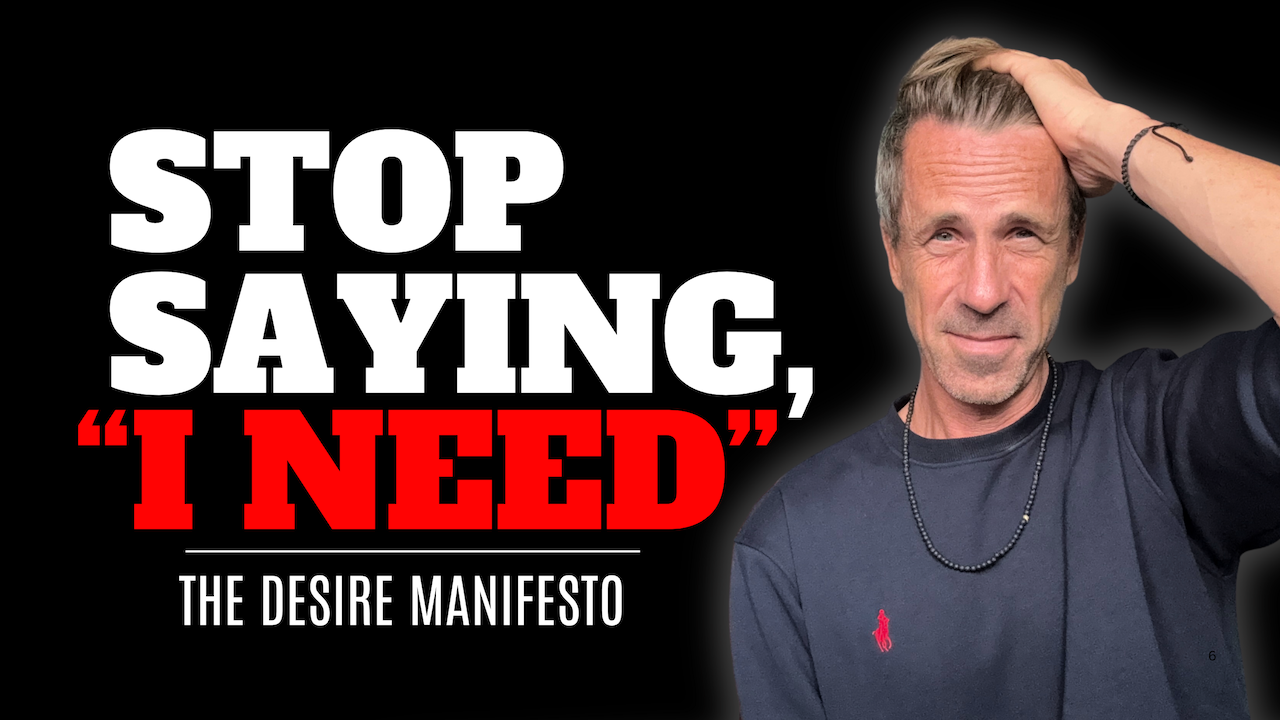
I Never Start A Sentence With “I Need”.

THE DESIRE MANIFESTO

The more you talk about your needs, the less your spouse wants to meet them.

How do I know that?

Because 10,000 hours of working with couples has made one thing crystal clear to me:

When you say ‘needs’ to your spouse, the hair on the back of their neck stands straight up.

You’ve probably heard the cliché advice that healthy communication means clearly expressing your needs.

But let me break something down for you:

Every time you say, “I need you to listen more,” “I need you to be more affectionate,” or “I need you to prioritize me,” they don’t hear what you’re longing for…

They hear pressure. Obligation. Another expectation.

And another way they’re failing you.

Eventually, the very person you’re trying to pull closer begins moving further away.

That’s why I want you to stop talking about your needs… and start revealing your desires.


I was working with a lot of couples this week, and the ‘needs’ theme came up way more than I like.

Now, I’m not saying we don’t all have relational needs.

Of course we do. We all want to know that we matter, and that our spouse cares enough about our connection to protect it.

What I am saying is that calling something a need does not make your spouse more willing to give it to you.

More often than not, they become defensive.

They shut down.

And leave you feeling so alone, you wonder if they even heard you.

Well, I heard you. And that’s why I’m writing you this manifesto.

To share with you a different perspective of how to get what you want from your spouse.

And I’m so confident that once you understand why the word ‘needs’ is damaging to your relationship …you’ll stop using it like Meredith and I have… and build a marriage that feels chosen and cherished.


People turn their wants into needs because they’re afraid.

They think that simply wanting something isn’t enough.

They think their desires won’t matter unless they can prove they’re hurting.

So “I want more affection” becomes “I need more affection.”

“I want to feel close to you” becomes “I need you to make me feel loved.”

Underneath all of it, you’re really asking:

“Will what I want matter to you?”

“Do I have to be falling apart before you’ll take me seriously?”

“Will you choose to care about me if I can’t force you to?”

What you don’t understand is that your spouse is human.

Sometimes they’re tired. 

Sometimes they’re thoughtless.

Sometimes they’re distracted, resentful, overwhelmed, or simply incapable of giving you what you want–in that moment.

If your ability to be okay depends entirely upon your spouse consistently meeting your needs, you are setting both of you up to fail.

Pretty soon, every misstep or missed moment becomes evidence that:

“I don’t matter.”

“I’m not important.”

“I’m not chosen.”

That is how one disappointment becomes an identity-level wound… and how a marriage slowly grows cold.


Most of us were never taught to live from desire.

We were taught to be realistic. To lower our expectations. To accept what we’ve been given and stop asking for more.

Eventually, we lose faith in two things:

That we are worthy of what we want.

And that we are capable of getting it.

So instead of building the marriage we desire, we keep presenting each other with an inventory of everything we still need.

“I have a need, and you need to meet it.”

“I have a need, and you have to fulfill it.”

When you live inside that scarcity mindset, you begin looking only for the moments when your partner doesn’t meet your needs.

That’s not how I do therapy. It’s not how I live my life. And it’s definitely not how Meredith or I approach our relationship.

We look for the things we want.

And we simply ask for them.

If couples became better at asking for what they wanted instead of repeatedly prosecuting one another for their unmet needs, I believe many of their hardest conversations would change almost overnight.

That’s not because every desire would suddenly be fulfilled.

It’s because desire is much more inviting than obligation.

Imagine you said:

“I want to feel your arms around me tonight.”

That isn’t an accusation.

It’s an invitation.

You haven’t told them how they’re failing.

You’ve shared with them how you want to be shown love.

Through my experience—having worked with well over a thousand couples and now being in my twelfth year doing couples therapy—I’ve watched this happen again and again.

The moment you make a conversation about unmet needs, it becomes acrimonious and resentful. 

One person feels deprived. The other feels inadequate. And both leave feeling more disconnected.

Now, I’m not a fool and am well aware that there are conditions a marriage requires to be healthy.

Loyalty. Honesty. Transparency. Fidelity. Commitment.

I’m not asking anyone to demote those into casual preferences.

I’m talking about the hundreds of ordinary moments in which we try to make our desires more important by presenting them as emergencies.

You shouldn’t have to manufacture an emergency for what you want to matter.

I want you to imagine two homes.

In the first home, everyone talks about what they need.

“I need you to help more.”

“I need you to listen.”

“I need more affection.”

“I need you to change.”

Everyone is keeping an inventory of what hasn’t been given. Everyone feels deprived. Everyone else feels inadequate.

Now imagine another home.

A home where everyone feels safe enough to reveal what they deeply want.

“I want to feel close to you.”

“I want more time together.”

“I want to know what’s happening inside you.”

“I want to feel your arms around me.”

In that home, nobody is guaranteed everything they ask for.

But nobody has to be ashamed of wanting it either. 

Or, more importantly, asking for it.

Nobody is so desperate that they have to convert a want into a need to get their desires to be taken seriously.

Which home would you rather live in?


I know what some of you are thinking:

“What if I tell my spouse what I want and they still don’t care?”

Then the problem is no longer your vocabulary.

Changing “I need” to “I want” will not cure indifference. It will not make an unwilling spouse suddenly become invested in your marriage.

But it will reveal something important.

There is a difference between a spouse who doesn’t understand what you want, a spouse who cannot give it right now, and a spouse who simply refuses to care.

You need to know which one you’re dealing with.

Desire does not guarantee that your spouse will move toward you.

But it gives them the clearest possible invitation to do so.


18 years deep, Meredith and I have never talked about our needs.

We simply tell one another what we want.

Not because we always get it. 

Because we’re not afraid of each other’s response when we hear it.

We don’t want to live in a home where it’s unsafe to say the thing under the thing.

Case in point:

My daughter came to me last year and said, “Dad, I want a horse.”

Should I have said ‘no’ and crushed a little girl’s spirit? Should I be the kind of father that ends a potential Olympic equestrian rider’s dream before it even started?

I wasn’t about to put a horse in our backyard the day after she asked.

But I’m not in the business of shaming my daughter for wanting a horse.

I’m in the business of being curious. 

Curious enough to ask, “Sweetheart, how can I help you get that horse?”

At 50, I want a PlayStation 5. Meredith doesn’t want me to have one (and honestly, she may be saving our family from losing me to Call of Duty).

The point is not that everyone gets everything they want.

The point is that a loving home makes room for people to express what they do want.

Sometimes–very often actually–we say no to each other. 

But not before we explore the request. Negotiate it. Postpone it. Or find another version of it. 

And we definitely don’t make one another feel foolish for wanting it.

I want you to get in touch with your desires. And then practice saying the two simplest words in your marriage:

“I want…”

As in, 

“I want intimacy.”

“I want a hug.”

“I want you to sit beside me.”

“I want a message from you when we’re apart.”

“I want to feel important to you.”

“I want to understand you.”

“I want to feel chosen by you.”

You don’t have to turn your desire into a need to make it legitimate.

You don’t have to collapse because it feels like you’re not allowed to ask.

You don’t have to prove that you cannot survive without it.

You are simply allowed to want something because it would make your life—and your marriage—more beautiful.


So I’m going to challenge you to talk to your partner tonight about what you truly want for your relationship.

Ask your spouse:

“What do you want for us?”

Not, “What do you need me to fix?”

Not, “What have we failed to give each other?”

Once again, ask each other, “What do you want?”

Then listen. Listen without defending yourself.

And be curious about why they want it.

Remember, your spouse doesn’t expect you to fulfill all of their desires.

They simply want to know that you care about what matters to them.

In solutions and strength,

Jonathan


P.S. If you want to go deeper into everything I talked about today and build a marriage that doesn’t feel disappointing, I wrote a book for you.

Choosing Us is available for preorder now through Amazon, Barnes & Noble, Walmart, and wherever books are sold.

Just do me one favor: when you preorder your copy, send me a DM or reply to this email and let me know.

Because this November, when the book launches, I’m personally leading a 6-week Chosen & Cherished Marriage Intensive, and everyone who preorders the book gets a spot completely FREE.

You’ll also receive all of the preorder bonuses (valued at $2,250) I’ve put together to help you start strengthening your marriage long before the book arrives.

I can’t wait to share my book with you.